

Blog Post
When a High-Performing Team Starts Losing Momentum
June 10, 2026 / Category: Third Level

It rarely happens all at once.
At first, it’s subtle.
- Communication gets shorter.
- Meetings feel heavier.
- Collaboration slows down.
- Energy drops.
- Trust weakens quietly beneath the surface.
And for leaders, one of the hardest realities to face is this:
A team that once performed exceptionally well can become disengaged faster than expected—especially during periods of rapid change, uncertainty, restructuring, or growth pressure.
Today’s business environment is demanding more from leaders than ever before. Teams are navigating shifting priorities, digital acceleration, economic pressure, hybrid work dynamics, and increasing emotional fatigue—all at the same time.
The result?
Even strong teams can lose clarity, confidence, and momentum.
A recent Harvard Business Review article highlights an important truth: the best leaders don’t simply push harder when performance slips. They pause long enough to reassess, reconnect, and realign their teams around a shared purpose.
https://hbr.org/2025/07/6-steps-to-reset-a-demotivated-team
And in today’s environment, that ability may be one of the most valuable leadership skills of all.
The Fear Most Leaders Don’t Say Out Loud
Senior leaders often carry a silent pressure:
- “What if my team burns out?”
- “What if we lose our top talent?”
- “What if momentum stalls at the exact moment we need to accelerate?”
- “What if I’m asking people to adapt faster than they emotionally can?”

These aren’t operational concerns alone.
They are leadership realities.
Because performance challenges are rarely just about productivity.
More often, they are symptoms of:
- unclear direction
- unresolved tension
- emotional exhaustion
- lack of trust
- or a disconnect between leadership and team experience
And ignoring those signals comes at a cost.
Why “Pushing Harder” Stops Working
Many organizations respond to low motivation with more pressure:
more meetings, more accountability, more urgency.
But pressure without alignment creates resistance.
High-performing teams don’t need constant intensity.
They need:
- clarity
- trust
- psychological safety
- shared ownership
- and leadership that creates stability during uncertainty
The strongest leaders understand that resetting a team is not a sign of weakness.
It’s strategic.
The Reset Modern Teams Actually Need
Resetting a team today requires more than a motivational speech.
It requires leaders who are emotionally intelligent enough to recognize when:
- morale is slipping
- communication is breaking down
- people no longer feel connected to purpose
- or high performers are quietly disengaging
Modern leadership is no longer just about driving results.
It’s about creating the conditions where people can sustain high performance without losing engagement, resilience, or trust along the way.
That’s the difference between temporary output and long-term performance.
Where Third Level Comes In
At Third Level, we help leaders navigate these exact moments.
Not with generic team-building exercises.
With proven leadership and organizational strategies designed to rebuild alignment, trust, accountability, and momentum—quickly and sustainably.
We work with executives and leadership teams to:
- reconnect teams around shared purpose
- strengthen communication and trust
- develop emotionally intelligent leadership
- reduce friction and disengagement
- create cultures where performance and people thrive together
Because when leaders address the human side of performance, everything changes.
Teams move faster.
Decisions improve.
Energy returns.
Results follow.
Learn more about our leadership development approach:
https://thirdlevel.com/leadership-development/
Your Team Doesn’t Need More Pressure. It Needs Leadership.
If your team feels stuck, disconnected, overwhelmed, or less engaged than it once did, the answer may not be to push harder.
It may be time to reset differently.
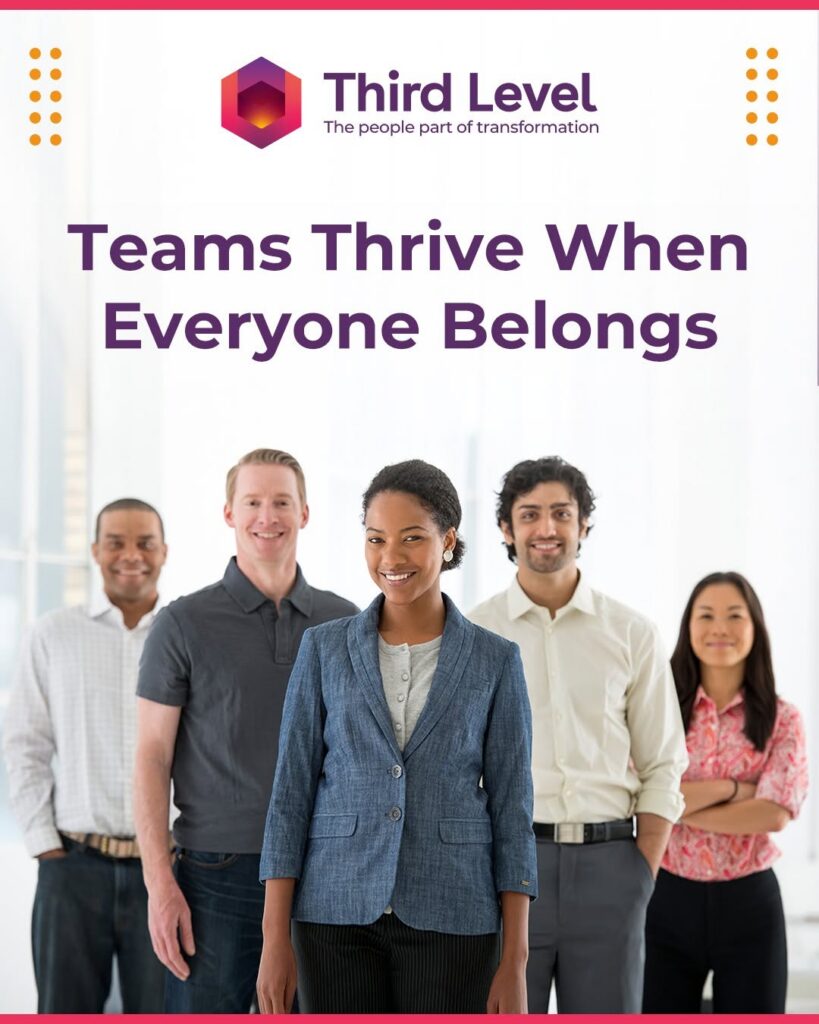
Belonging fuels collaboration, trust, and resilience. When people feel seen and valued, they become more engaged and are more willing to share their best ideas. Leadership isn’t just about managing people—it’s also about creating spaces where they’re inspired to bring their full selves to work. Want to learn more? We are here!
The organizations that will outperform in the years ahead will be the ones led by executives who know how to restore clarity, trust, and momentum before disengagement becomes culture.
Let’s talk about what your team needs next.
Connect confidentially with Third Level at Info@ThirdLevel.com
Follow us on Instagram @ThirdlevelTeams
Because resilient teams are not built by accident.
They are built by leaders willing to lead differently.